plantationgrandluauOlowalu Plantation House
A Grand Plantation Celebration at Olowalu
2024-08-10Olowalu Plantation House
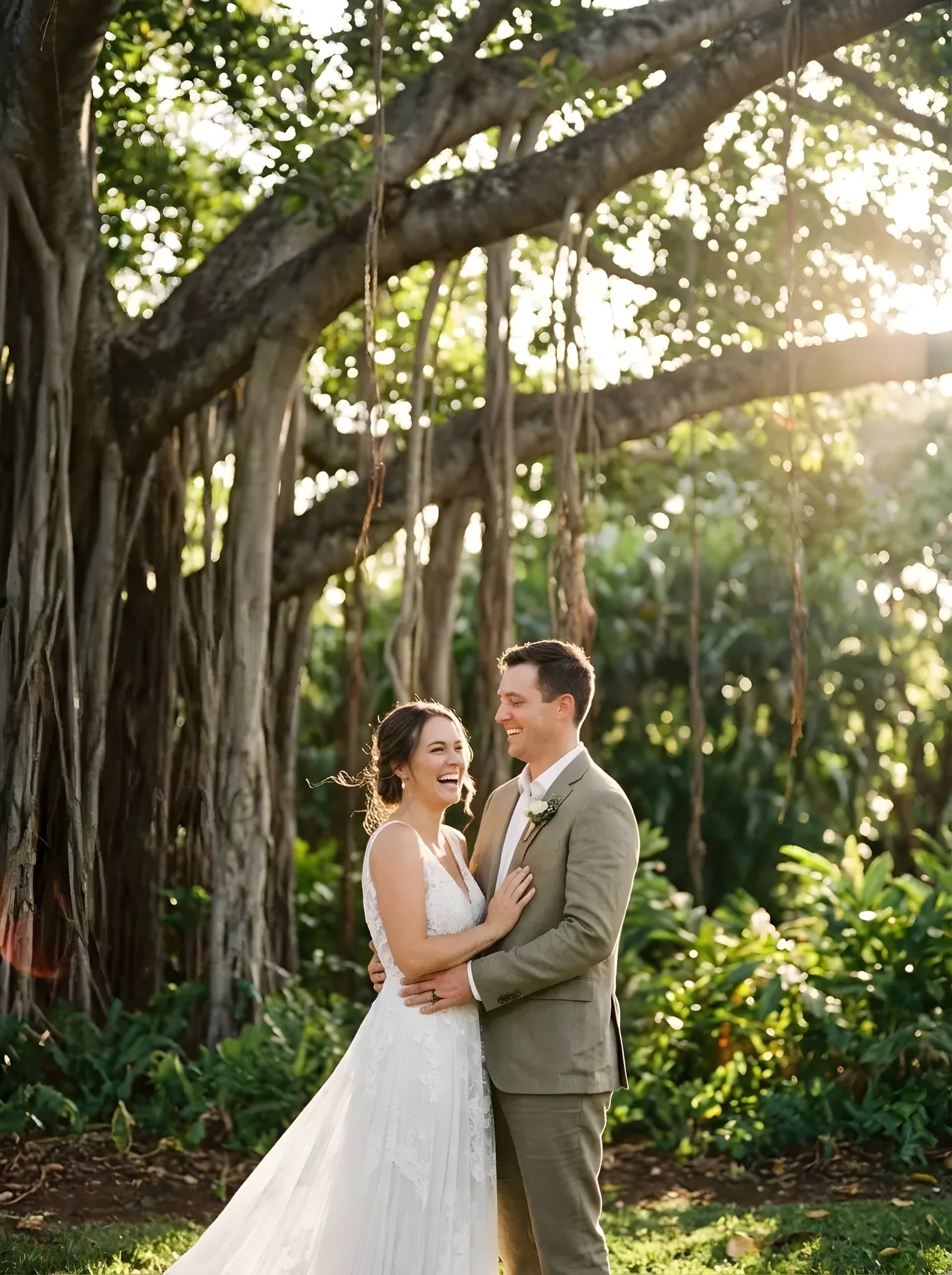
Lisa and Christopher knew from the start that their wedding would be more than a single day. With 150 guests flying in from San Francisco, New York, Chicago, Austin, and a few places in between, they felt strongly that asking people to travel five hours over open ocean deserved more than a four-hour reception. They wanted a weekend. Three full days on Maui where their families and friends could actually get to know each other, where the wedding itself would be the centerpiece of something larger. The Olowalu Plantation House, with its Great Lawn stretching from the base of the West Maui Mountains down toward the ocean, gave them the room and the setting to make it happen.
Lisa found us through a friend who'd gotten married on Maui two years earlier. She called on a Wednesday afternoon in January, eight months before the wedding date, and talked for over an hour. She was organized. She had spreadsheets. She'd already contacted three venues and had preliminary quotes from two florists. But she was also honest about what she didn't know: how to coordinate 150 guests across multiple days on an island most of them had never visited, how to handle the logistics of welcome bags and airport transfers and dietary restrictions, and how to keep the whole thing from feeling like a corporate retreat. That's where full wedding planning made the difference. We took her spreadsheets and turned them into a plan.
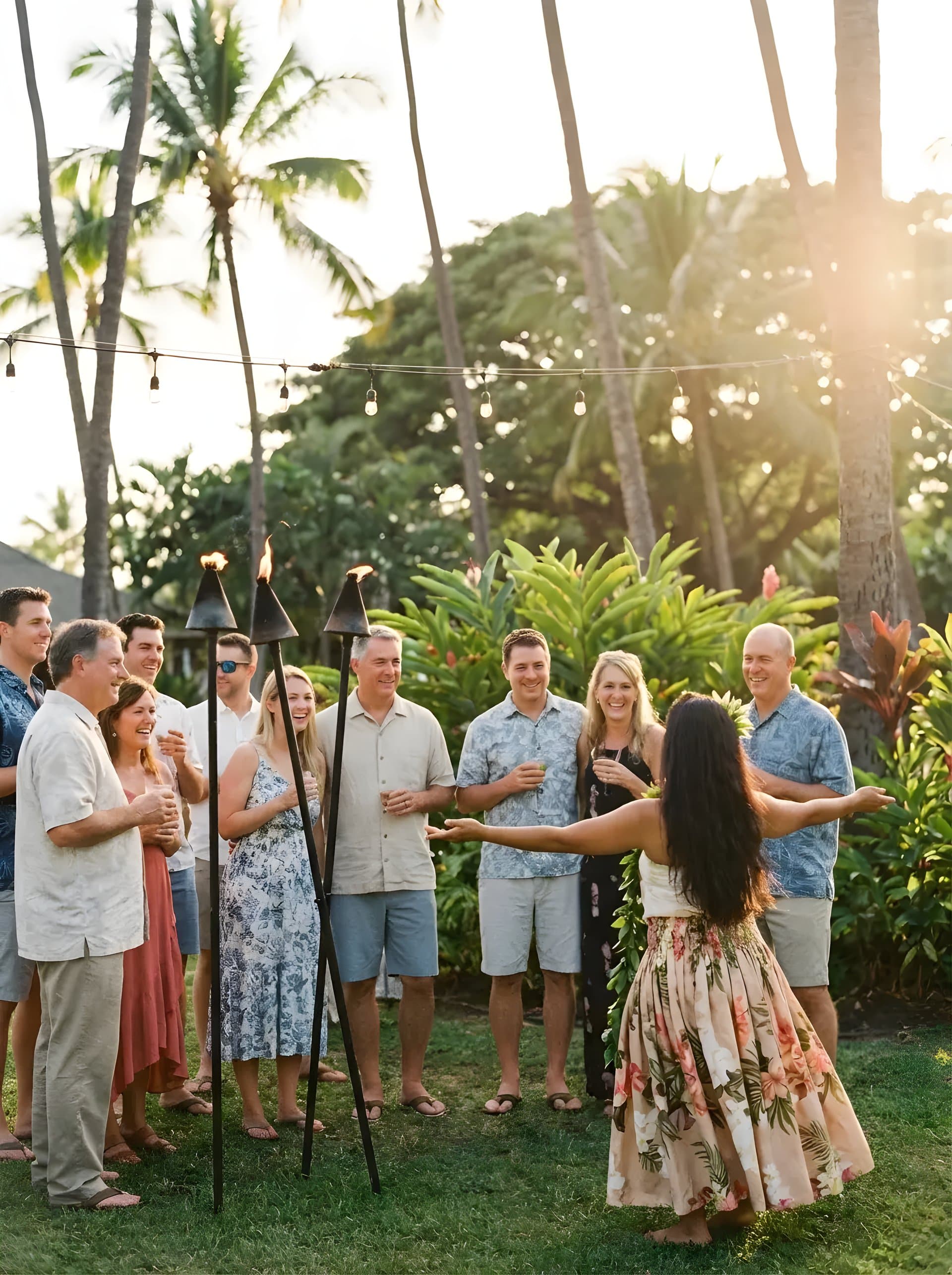
The weekend started on Friday evening with a welcome luau at the Plantation House. This wasn't a resort luau with fire dancers and buffet lines. Lisa and Christopher wanted something more authentic. We worked with a local Hawaiian family who specializes in traditional imu preparation, the underground oven technique where a whole pig is wrapped in banana and ti leaves and slow-cooked over hot volcanic rocks for eight to ten hours. The imu was dug on the property Thursday night and lit before dawn on Friday. By the time guests arrived at six o'clock, the pig had been cooking for over twelve hours. The smell, smoky and rich and slightly sweet from the ti leaves, hit you the moment you stepped onto the property.
Guests gathered on the lawn with drinks, mai tais and local beer and fresh coconut water, while a trio of Hawaiian musicians played old-school slack-key and traditional mele. At sunset, the imu was opened in a small ceremony. The pig was pulled from the ground, unwrapped, and the meat fell apart in steaming sheets. It was served alongside poi, lomi lomi salmon, haupia, sweet potato, and rice. People ate with their hands. Christopher's mother, a woman who Lisa described as "very Connecticut," was sitting cross-legged on a blanket eating kalua pig with her fingers by the end of the night. That was the moment Lisa knew the weekend was going to work.
After dinner, a halau, a traditional hula school, performed three dances. The first two were older, sacred pieces: an oli, a chant, followed by a hula kahiko danced to gourd drums. The third was a modern hula auana dedicated to the couple. The lead dancer, a woman in her fifties who had been performing hula for four decades, moved with the kind of grace that makes you forget you're watching someone dance and instead feel like you're watching someone speak. Multiple guests told us afterward that it was the most moving performance they'd ever seen. Christopher's father, a retired Marine who doesn't cry, had tears running down his face.
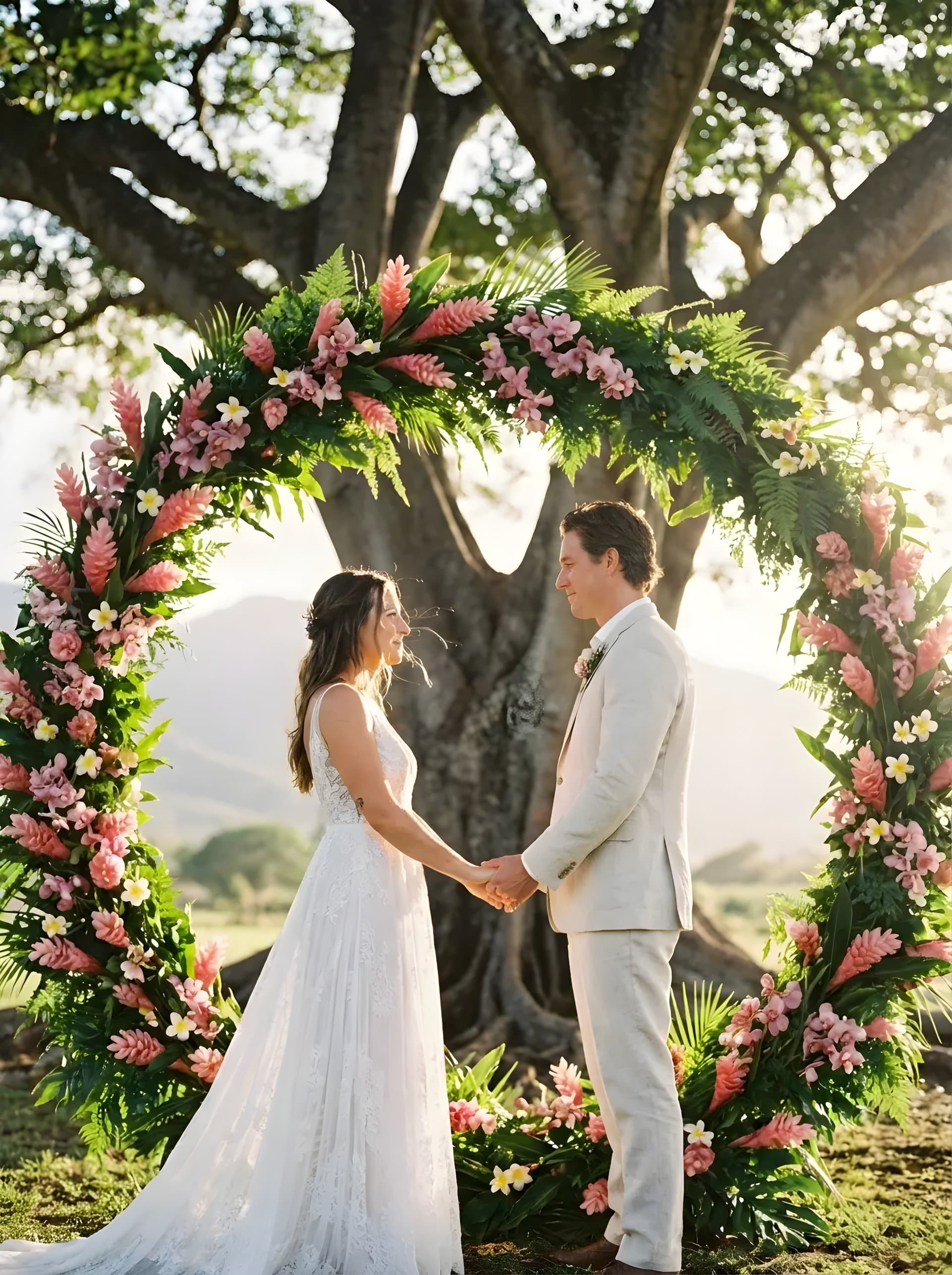
Saturday was the main event. The ceremony was set for four o'clock on the Great Lawn, timed so the West Maui Mountains would be backlit by the afternoon sun. Our florist had built a circular arch, about nine feet in diameter, from a structure of bent willow wrapped in monstera leaves, white phalaenopsis orchids, hanging green amaranthus, and clusters of ivory roses. It stood at the far end of the lawn with the mountains rising behind it. Guests were seated in white folding chairs arranged in a wide fan shape, with an aisle lined by glass lanterns and low arrangements of tropical greenery and white anthuriums.
August on Maui's west side is dry and warm. The day hit 87 degrees by early afternoon, but by four o'clock a trade wind had picked up from the northeast, dropping the temperature to the low 80s and sending a steady breeze across the lawn. Lisa walked down the aisle on her father's arm in a flowing silk crepe gown with a long train that caught the wind behind her like a sail. She carried a bouquet of white garden roses, tuberose, and stephanotis, and the tuberose scent was so heavy in the warm air that several guests mentioned it unprompted afterward. Christopher waited at the arch in a navy suit, no tie, his jaw tight and his eyes wet.
Their officiant was a Hawaiian kahu who conducted the ceremony in a mix of English and Hawaiian. He opened with a pule, a prayer, and blessed the couple with ti leaves dipped in ocean water that had been collected from the beach below the property that morning. The couple exchanged maile lei, the open-ended lei made from twisted maile vine that carries a sharp, woody scent nothing like the sweet plumeria lei most visitors associate with Hawaii. Maile is traditional in Hawaiian weddings. It means respect and commitment. The scent stays on your clothes for days.
Christopher's vows were written on the back of a vintage Maui postcard he'd found in an antique shop in Lahaina. He read them holding the postcard in both hands, and his voice cracked twice. He talked about the first time he visited Lisa's apartment and noticed she had a framed photo of Maui on her wall, and how he took it as a sign. Lisa's vows were longer. She talked about how Christopher had flown to San Francisco eleven times in their first year of long-distance dating, how he never complained about the red-eye flights, and how she realized she wanted to marry him the night he showed up at her door at midnight with a suitcase and said he'd moved his meetings so he could stay an extra day. Honest, specific, earned. The kind of vows that make strangers cry.
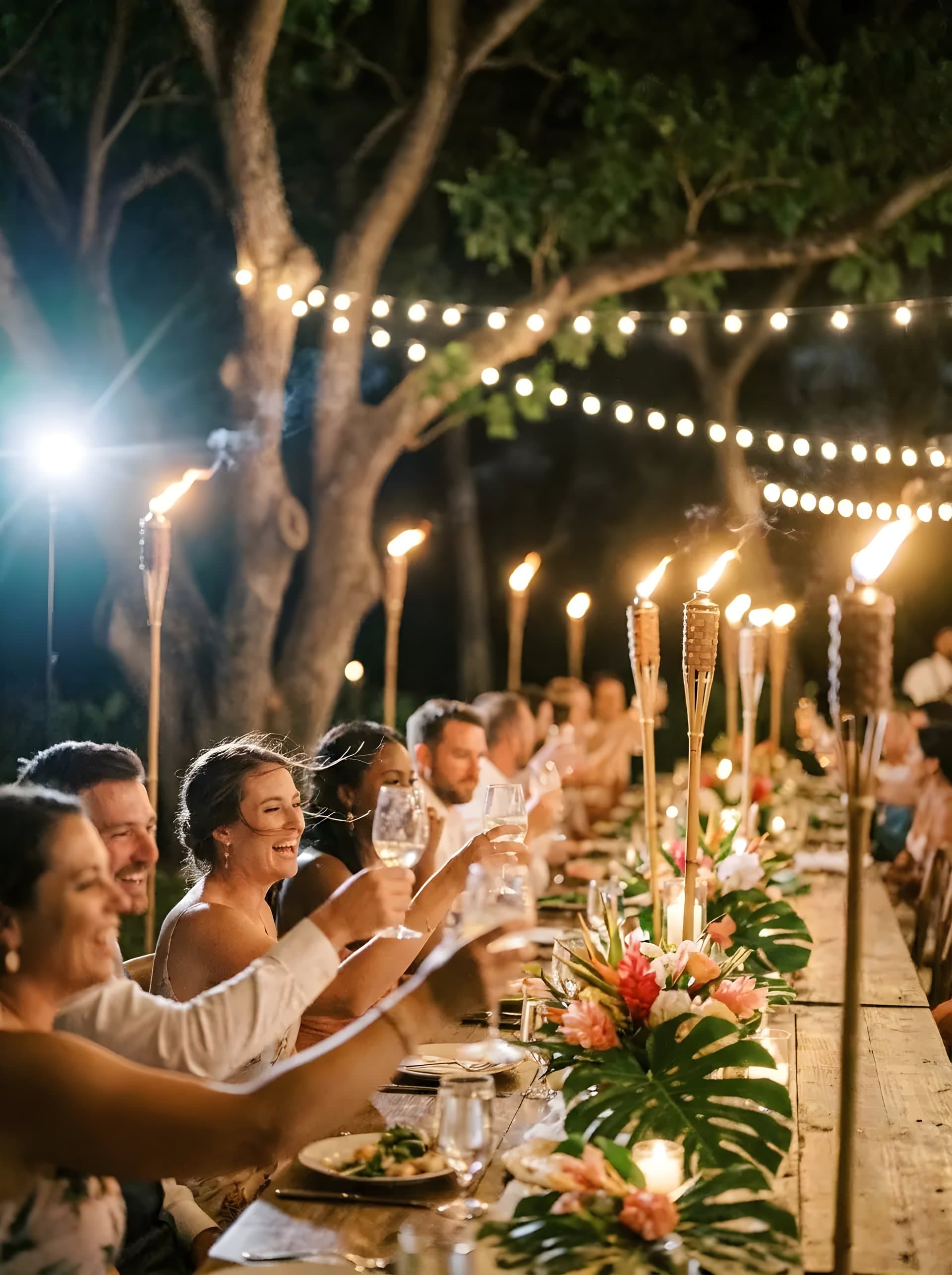
As the sun set behind the mountains after the ceremony, tiki torches were lit along the pathways and around the perimeter of the reception area. The transition from ceremony to cocktails to dinner was smooth, which matters more than people think with 150 guests. Cocktail hour happened on the lanai with passed appetizers: ahi tartare on wonton crisps, grilled shrimp with chili-lime aioli, local goat cheese crostini with Maui onion jam. A bartender mixed signature mai tais with fresh Maui pineapple juice and a float of dark rum, served in custom coconut cups that Lisa had sourced from a vendor on Oahu.
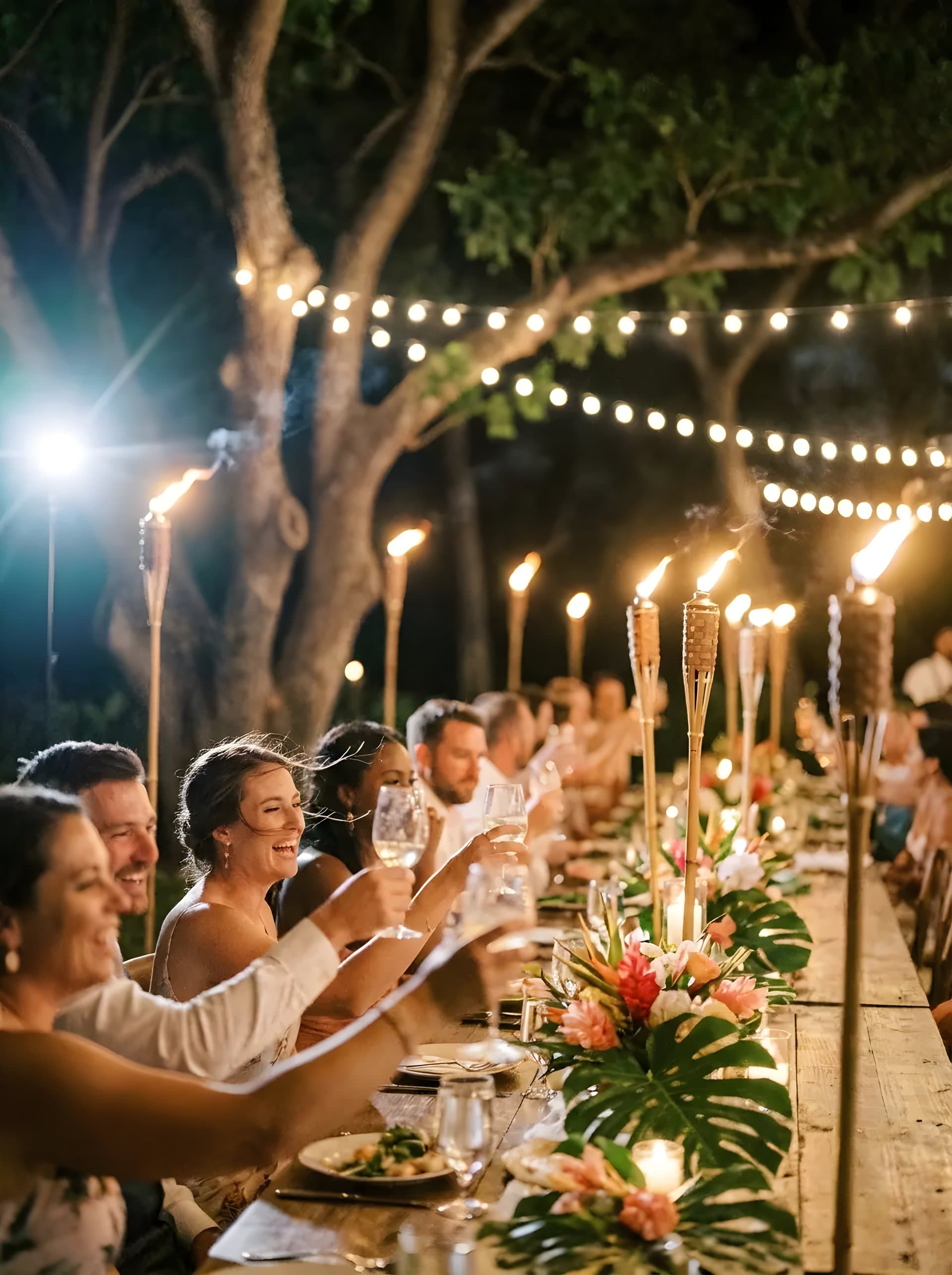
Dinner was seated under a canopy of market string lights strung between the property's towering palm trees. Ten long communal tables, each seating fifteen, were set with linen, brass charger plates, and low centerpieces of tropical greenery, orchids, and floating candles. The menu was seven courses of Hawaiian-fusion food: chilled coconut soup with Kula strawberries, a seared ahi salad, a Maui onion tart, macadamia-crusted mahi-mahi with a beurre blanc, braised short rib with taro puree, a palate cleanser of lilikoi sorbet, and a dessert trio of haupia panna cotta, guava cake, and chocolate-covered macadamia clusters. The meal took two hours. Nobody rushed.
After dinner, a twelve-piece band from Honolulu set up on a portable stage at the edge of the lawn. They opened with the couple's first dance, a Stevie Wonder song that Christopher had been practicing, and then tore into a set list that covered everything from Motown to modern pop to a four-song Hawaiian medley that got the entire crowd on their feet. The dance floor, a temporary hardwood platform laid over the grass, was packed from nine o'clock until the band's final song at midnight. The live Hawaiian music mixed with soul and funk was exactly the combination Lisa had described in her initial brief: "I want people to dance until their feet hurt."
Sunday morning was the farewell brunch. It was deliberately casual. Tables and chairs on the lawn, buffet-style, come-as-you-are. Macadamia nut pancakes, Maui-grown coffee, acai bowls, fresh fruit, and a made-to-order omelet station. Guests lingered for hours, swapping stories about the weekend, showing each other photos on their phones, making plans to visit each other on the mainland. Lisa and Christopher moved from table to table, still looking slightly stunned that the whole thing had actually happened.
Lisa sent us an email a few weeks later. "We keep watching the video," she wrote. "Every time I think I've processed the weekend, I notice something new. A moment between guests I didn't see. A look on Christopher's face during the hula. The way the light hit the mountains during our vows. We didn't want it to end. And honestly, for those three days, it felt like time stood still."
Every couple, every venue, every sunset is different. That is exactly the point.
150+
Maui Weddings
5.0
Client Rating
8+
Years on Island
100%
On-Time Execution
“We wanted something intimate and real. MOM gave us exactly that — no cookie-cutter packages, just a wedding that felt like us.”
Emma & James
Kapalua Bay
Inspired by This Story?
Every love story is different. Share yours with us and we'll help you create something just as unforgettable.